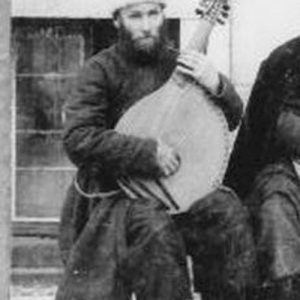
BANDURA AND ITS HISTORY
The instrument was first noted in a 6th century Greek chronicle in a reference to warriors from Ukrainian territories who played lute-like instruments. This lute-like instrument, called a kobza, was much smaller, more circular, and had fewer strings than the modern bandura. In time, more strings were added, some of which were strung along the side of the instrument. This made frets along its neck obsolete.
In the middle ages the bandura became prominent in the courts of Eastern Europe, much like the lute in Western Europe. It was used primarily for dance pieces and song accompaniment. It also enjoyed great popularity among the Ukrainian kozaks who developed a unique repertoire for the instrument. From their ranks arose a new school of Ukrainian professional musicians, similar to the troubadours of France. They were called kobzari (singular form is kobzar).
The kobzari developed a unique Homeric epic song form known as the duma (pronounced dooma), literally meaning thought or reflection (plural form is dumy). Sung to the accompaniment of the bandura, the dumy depicted the heroic exploits of the Ukrainian kozaks and their quest for peace and freedom. In 1873, at the 3rd Archeological Conference held in Kyiv, western scholars and composers first heard dumy performed by a blind kobzar named Ostap Veresai. His moving performance inspired the publication of numerous articles and books on the subject and had a significant influence on the development of the musical form known as dumky (e.g., Dvorak’s “Dumky Trios” and Tchaikovsky’s “Dumky”).
At the beginning of the 20th century, there was a renewed interest in the bandura and it became popular among the urban Ukrainian populations. As bandura ensembles formed and its popularity grew, demands for new instruments also grew. During this time there was considerable innovation and experimentation with technique and structure. New banduras began to be mass produced with a large number of strings, tuned chromatically rather than diatonically (like a piano rather than a guitar), and levers were added to expedite rapid transposition (playing in a different key, etc.). Conservatory courses were organized and professional composers were commissioned to create new compositions specifically written for this instrument.
Hnat Khotkevych is considered to be the father of the modern bandura. A trained pianist and violinist, he learned to play the instrument by observing and learning from old Kobzari. While always honoring the traditions and methods of the Kobzari, Hant contributed to the evolution of the traditional Kobzar bandura into what today is known as the modern Kharkiv bandura. He was instrumental in expanding its voice and repertoire to include ensemble playing.
This period of history of the bandura coincided with the rise of Ukrainian patriotism and nationalism and subsequent flourishing of arts. Unfortunately, it did not last long. In a direct political turnabout, the Soviet government resolved to wipe out all vestiges of Ukrainian nationalism by destroying their culture. In 1935, blind kobzari from all corners of Ukraine were assembled in Kharkiv under the pretense of an ethnographic conference, where supposedly their songs and stories would be collected and recorded, only to be executed.
Persecution, arrest, and exile became a way of life for countless Ukrainian artists and bandurists. They sought refuge and solace in harbors such as the United States and Canada where they were able to perpetuate their art unhindered.